Balance Art Definition Movement and Rhythm in Art Definition
When nosotros hear the word rhythm, we probably think of music. Beats. Tempos. Melodies. Rhythms that motion us. When it comes to rhythm in art the beat changes a flake, and so to say, information technology comes in all unlike shapes, sizes, and colors. In this article we will talk over and explore the question around, "What is rhythm in art?" with accompanying rhythm art examples.
Tabular array of Contents
- ane What Is Rhythm in Art?
- two The 5 Types of Rhythm in Art
- 2.1 Regular Rhythm
- 2.2 Alternating Rhythm
- 2.3 Flowing Rhythm
- 2.iv Progressive Rhythm
- two.v Random Rhythm
- 3 Summary of Rhythm in Art
- 4 Principles of Art – Further Readings
- five Oftentimes Asked Questions
- 5.one What Is Rhythm in Art?
- 5.ii What Are the Types of Rhythm in Art?
- 5.3 What Are the Principles of Fine art?
What Is Rhythm in Art?
Commencement, we volition provide a brief overview of what rhythm is and where information technology comes from in visual arts. Rhythm in fine art is office of several principles of art. These principles can too be called design principles, they are namely, residual, accent, motion, unity, harmony, diverseness, proportion, scale, and rhythm.
There are diverse definitions of the word "rhythm", one being, according to the Merriam-Webster Online Lexicon, is that rhythm is "move, fluctuation, or variation marked by the regular recurrence or natural flow of related elements".
The above rhythm definition points to its inherent meaning, which is that rhythm is created by the repetition or pattern of various elements. In visual arts, this would exist the art elements, which consist of color, value, line, shapes, forms, space, and texture.
 Le Chahut (1889) past Georges Seurat; Georges Seurat, Public domain, via Wikimedia Commons
A rhythm art example would be applying like colors next to 1 another in a sequence or an arrangement of shapes or lines that create a menses or move to the artistic composition, and as a result, this flow or move creates the rhythm.
To distill the essence of rhythm tin can also exist challenging to reach or apply in artwork as there are many ways to create it in art. This also allows artists of all modalities, be it cartoon, graphic design, painting, or sculptures and installations, the ability and freedom of expression to play around with rhythm and utilize it in many means to create the desired effect for their artworks.
Artists can either cull to create a hyper-energized or dynamic artwork, something more calming and fluid, or something more orderly and geometrically structured. It volition all exist dependent on how the different art elements, mentioned in a higher place, are practical and combined.
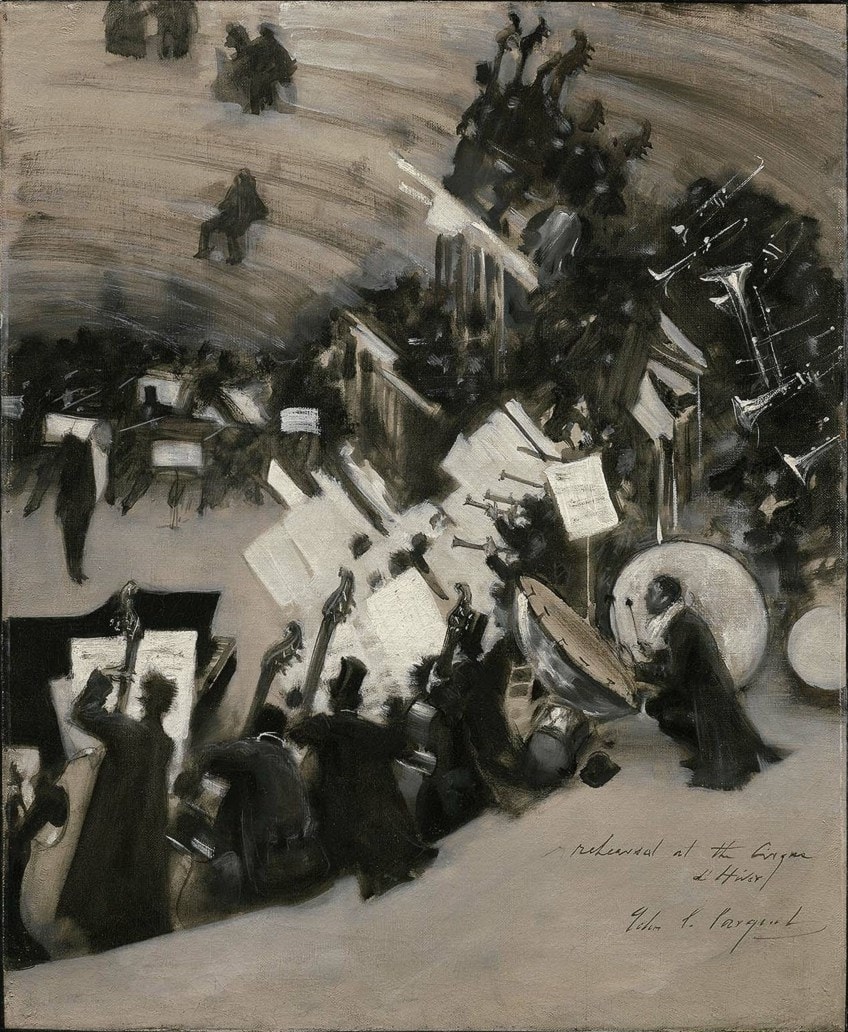 Rehearsal of the Pasdeloup Orchestra at the Cirque d'Hiver (1879-1880) by John Singer Sargent;John Vocalist Sargent, Public domain, via Wikimedia Eatables
The Five Types of Rhythm in Art
It is important to note that some art sources provide iii master types of rhythm and other art sources provide five. Below we will talk over the 5 types of rhythm in fine art, which are also the techniques utilized to utilize this principle in a composition. We will likewise provide several rhythm art examples from different artists throughout fine art history.
Regular Rhythm
Let u.s.a. start with the regular rhythm in art, which is simply what its name suggests, regular. A regular rhythm is consistent with its motifs. Whether different art elements are utilized, for example, color, line, or shapes, these are arranged in fifty-fifty and consistent patterns. Nevertheless, normally similar art elements or motifs are bundled to create regularity.
Some examples frequently used from the world of sound include imagining the rhythm of a heartbeat, a clock, or a tap dripping. These are all regular and consistent.
With this, regular rhythm in art is characterized by simplicity and ease, think of drawing repeating horizontal or vertical lines next to or on top of one another; evenly spaced, information technology will create an fifty-fifty visual rhythm.
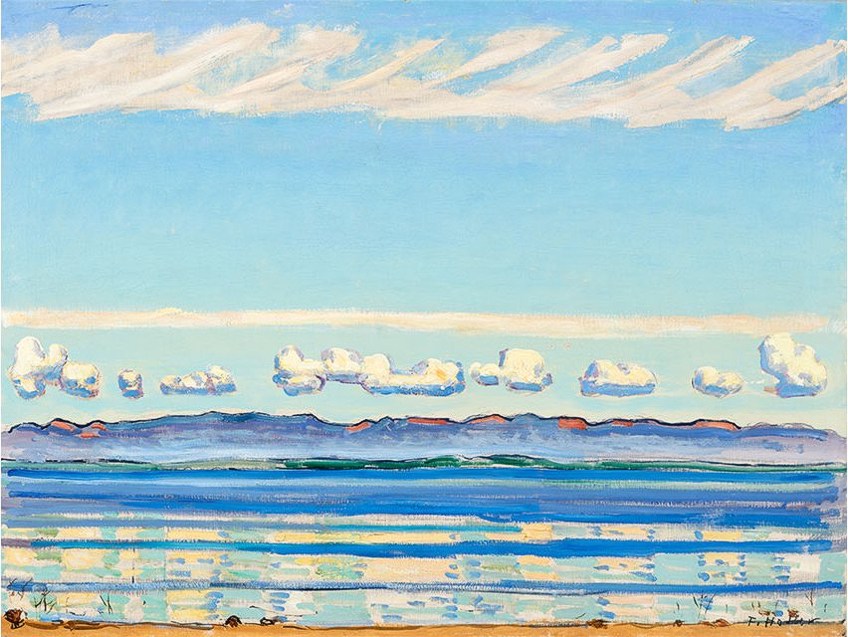 On Lake Geneva: Landscape with Rhythmic Shapes (1908) by Ferdinand Hodler;Ferdinand Hodler, Public domain, via Wikimedia Commons
Conversely, if there is too much of a regular rhythm in an fine art limerick it tin appear boring or too repetitive. However, this can exist countered past calculation more than variety here and there inside the same limerick.
An example of this tin can be found in the oil painting Autumn Plowing (1931) by the American artist Grant Forest. Hither we run into in the middle of the composition a regular rhythm created by the large grass bundles on the plowed field also equally the plow lines in the foreground of the composition.
Withal, surrounding these are different lines from the surrounding hills, which create a different rhythm adding diverseness. This can too be viewed equally a random rhythm example, which nosotros will talk over in more particular beneath.
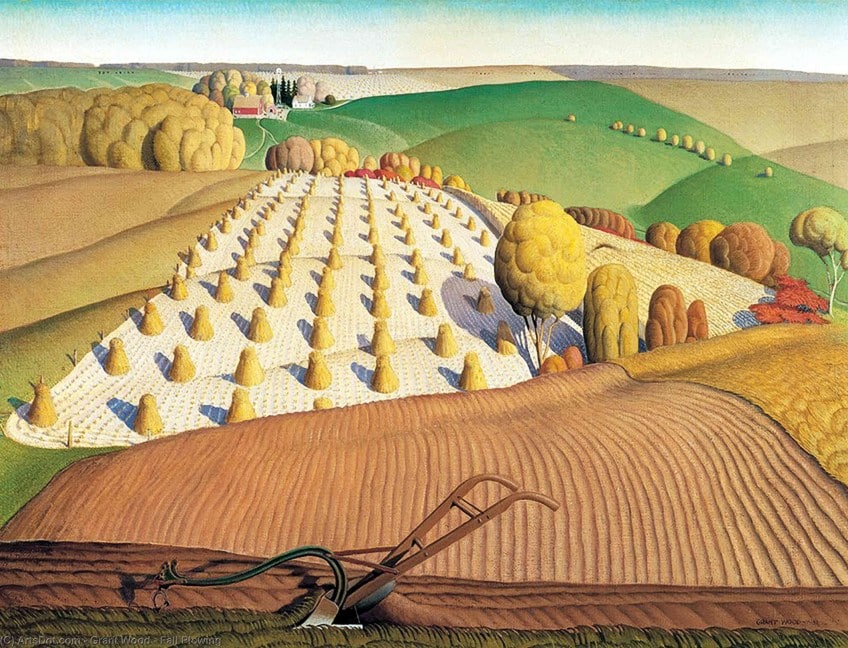 Autumn Plowing (1931) by Grant Woods;Grant Woods, Public domain, via Wikimedia Commons
Several other regular rhythm art examples include The Iv Trees (1891) by Claude Monet, which forms role of his Poplar Series (1981 to 1900). In this painting there are four trees along the banks of the Epte River, they appear evenly spaced and create consistent vertical lines in the limerick.
Monet'due south other painting from this series is similar, for example, Poplars at the River Epte (1900), which depicts 7 trees running in a line. What creates a regularity here is the similarity of the trees, which are also positioned close together and all in vertical lines.
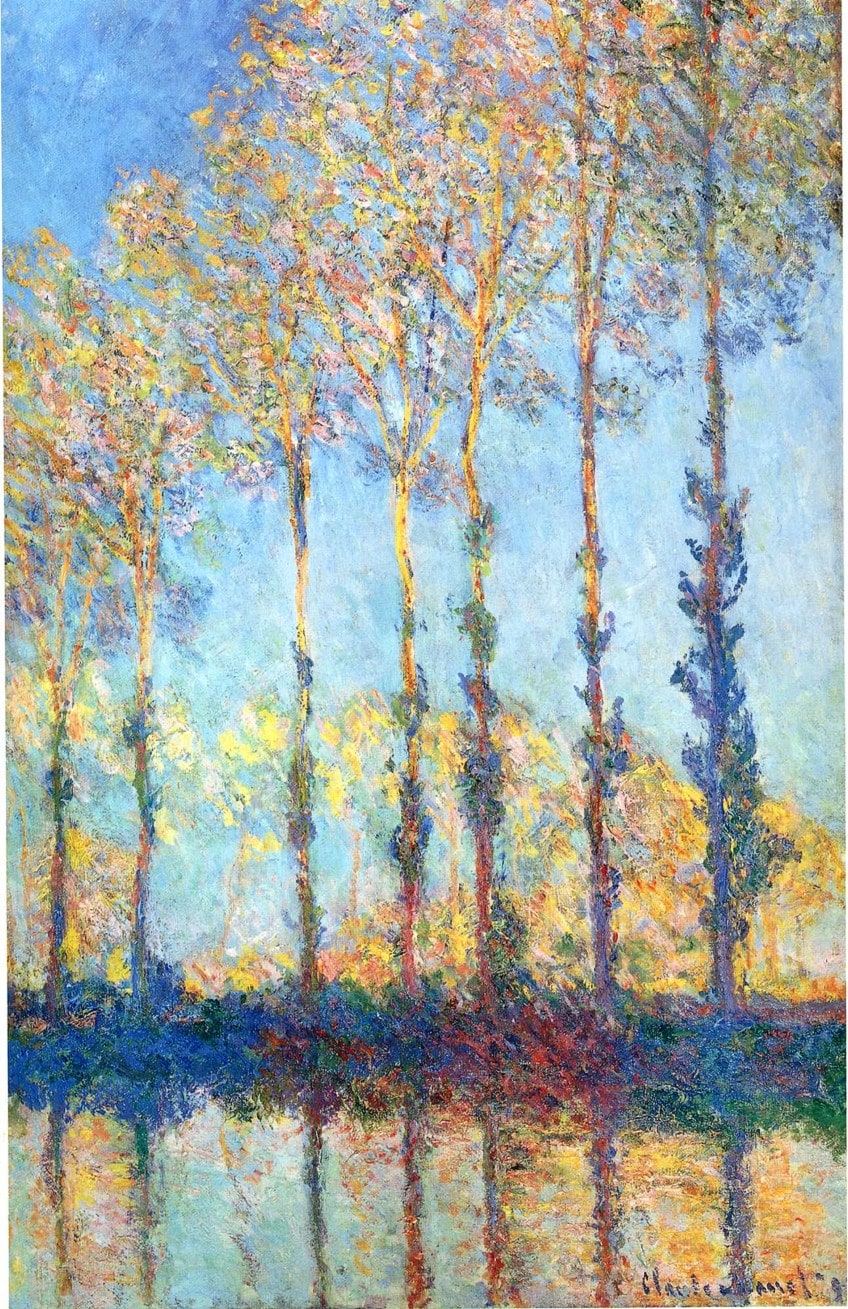 A Row of Poplar Trees Line the River Epte (1819) by Claude Monet;Claude Monet, Public domain, via Wikimedia Commons
The American artist Donald Judd produced installations or "stacks" like Untitled (1967) and Untitled (1968), among others, which consists of rectangular shapes all equally sized and positioned against a wall and spanning from the ceiling to the flooring; there are also equal distances between the rectangular box shapes.
Judd's stacks create a consequent flow, so to say, up and down the wall infinite, creating a regular rhythm without any other surrounding rhythms or elements that change its flow. The stacks are besides the aforementioned color, which adds to the consistent rhythm.
Alternate Rhythm
An alternate rhythm in art consists of more than than one, oftentimes ii, unlike motifs arranged in a pattern. According to some art sources, an alternating rhythm in art is similar a regular rhythm, simply with more intricacies, sometimes shapes are placed in different directions. A mutual case of an alternating rhythm in art is that of a chessboard with its blackness and white squares.
The motifs may vary in color or shape, or any other art chemical element, merely the result will give the composition more character, significant, and movement. It will also create more variety and reduce potential plainness that may result from a regular rhythm.
According to some art sources, there are disadvantages to an alternate rhythm in art as it may also crave more attending to detail to convey it accurately, especially if it is created by hand, and if not practical properly it can potentially appear too busy or "cluttered".
Some rhythm fine art examples include the Surrealist/Op creative person M.C. Escher's Lizard (1942), in which we see alternating lizard shapes in brown, black, and white, each molded alongside the other. While in that location are no evident gaps between the lizard shapes the alternating colors and specific arrangement gives the limerick a unique rhythm that does non make information technology appear as well cluttered.
The Orphism artist Robert Delaunay created numerous compositions in a diversity of colors and shapes that bordered on abstraction. With this Delaunay'southward artworks are filled with dynamism and motion, one example is his oil on sail Endless Rhythm (1934).
This painting is equanimous of circles and curved lines, otherwise also semi-circles, and running straight through the heart is an unsaid straight line.
There is an alternating rhythm created betwixt diverse elements here, for case, in the big blackness and white circles there are alternating colors bordering the top and bottom circles; the height circle'south left half is yellowish, and the correct half is blue, while the lesser circles' left half is blue, and its right half is xanthous.
Furthermore, the big black and white circles appear underneath the smaller, alternating in color, gray and blue circles on top. These are further contrasted past the alternating colors of the thick line swirling through them creating semi-circles.
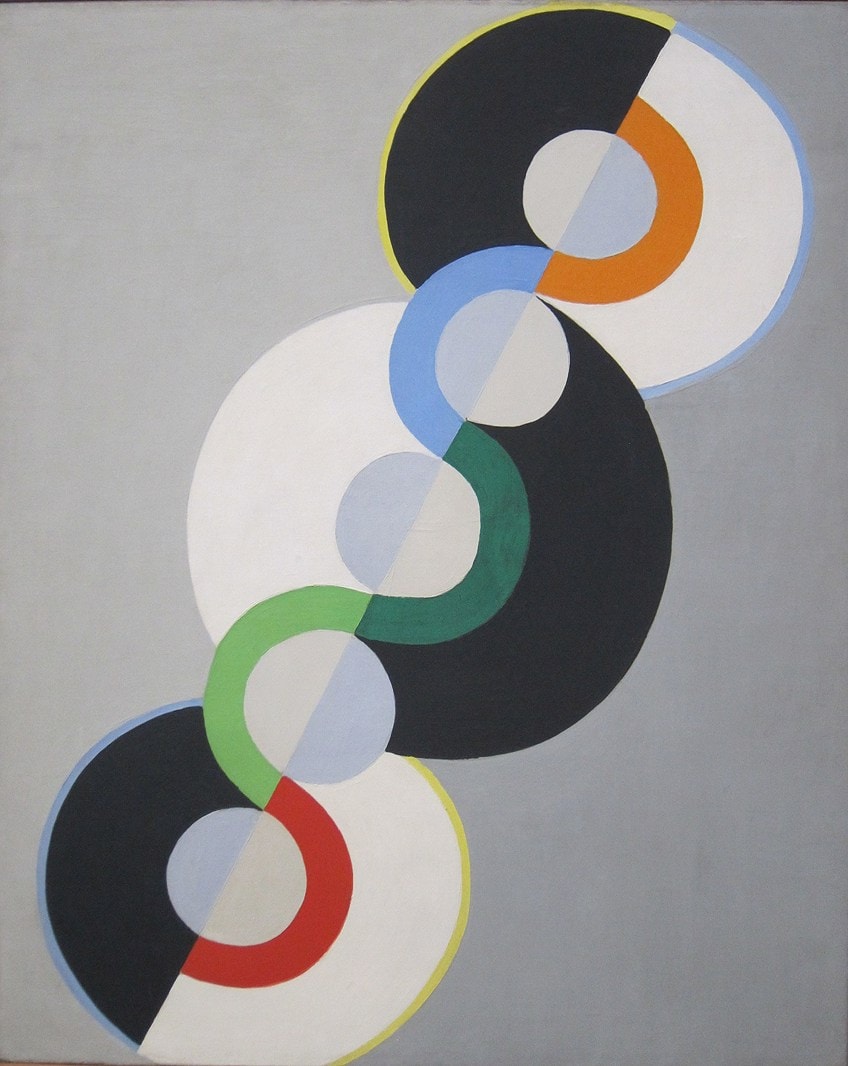 Endless Rhythm (1934) by Robert Delaunay;Robert Delaunay, CC0, via Wikimedia Commons
Flowing Rhythm
A flowing rhythm in art is when a blueprint follows the "organic" patterns fabricated by nature, which are typically round or curved lines and shapes and oftentimes described as "undulating", which means ascent and falling, normally in the grade of waves. Flowing rhythm in art provides the visual composition with more than character and dynamism, specially if a wave is portrayed. Furthermore, the flowing rhythm provides a pathway for our gaze.
While the flowing rhythm in art is characterized more by art elements like curved lines and shapes, equally mentioned above, other art elements can exist practical to emphasize it like color, value, size, and and then along.
A famous flowing rhythm art example is the Japanese woodblock print by Katsushika Hokusai, titled The Great Wave off Kanagawa (1831). In this limerick, we see a large moving ridge to the left near to envelop the pocket-size boats on the ocean's surface. The big wave is surrounded past other smaller waves and curves that give the unabridged composition a flowing rhythm and undoubtedly a dynamic movement, which also evokes emotional aspects.
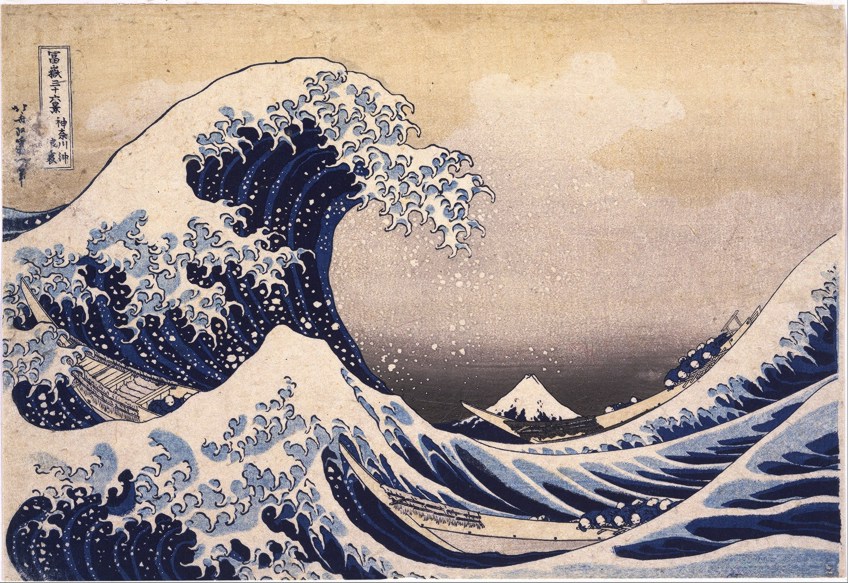 The Great Wave off Kanagawa (1831) by Katsushika Hokusai; Katsushika Hokusai, Public domain, via Wikimedia Commons
Another example includes The Scream (1893) by Edvard Munch, although here the flowing rhythm is created past the swirling brushstrokes evident in the sky and landscape surrounding the screaming figure standing on the bridge, who is also painted in flowing brushstrokes. The entire composition is undulating, and the rhythm creates a strong emotive quality.
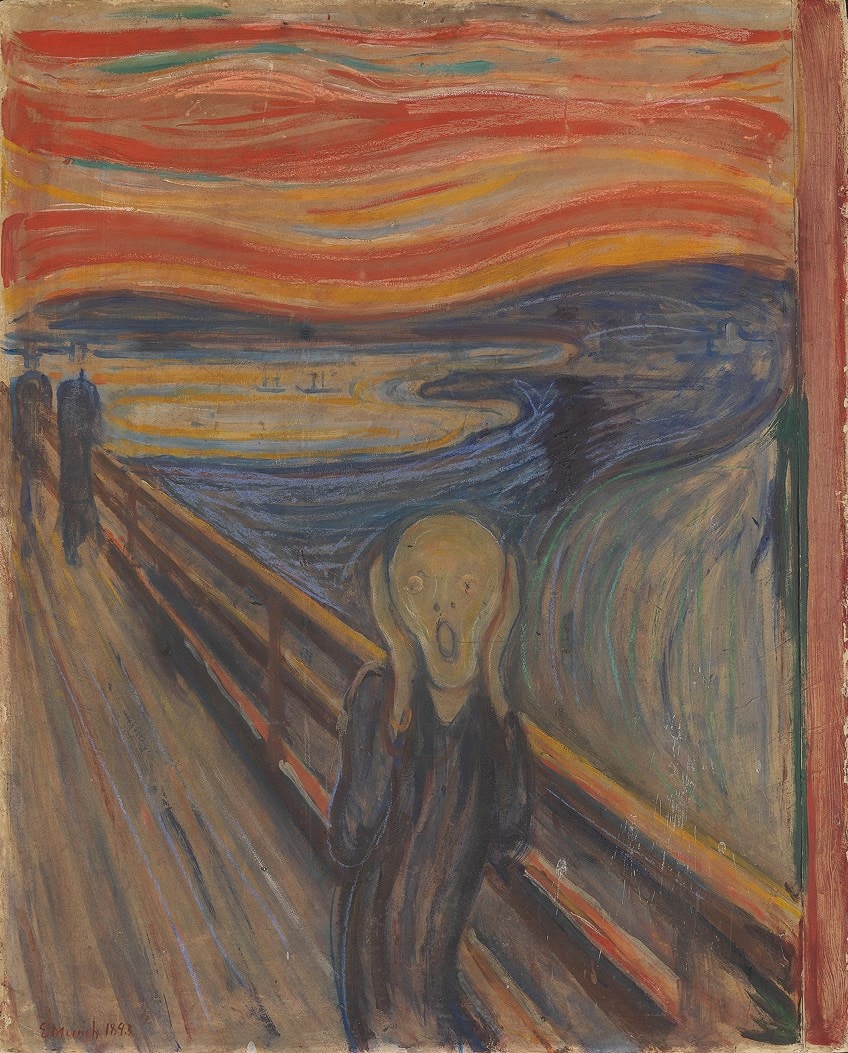 The Scream (1893) past Edvard Munch; Edvard Munch, Public domain, via Wikimedia Commons
We see similar emotive qualities evoked from a swirling landscape in one of the about famous paintings from the Dutch Vincent van Gogh, titled The Starry Dark (1889). In this limerick, Van Gogh depicts a starry nighttime heaven in strong swirls of paint, the texture of the paint further emphasizes its dynamism.
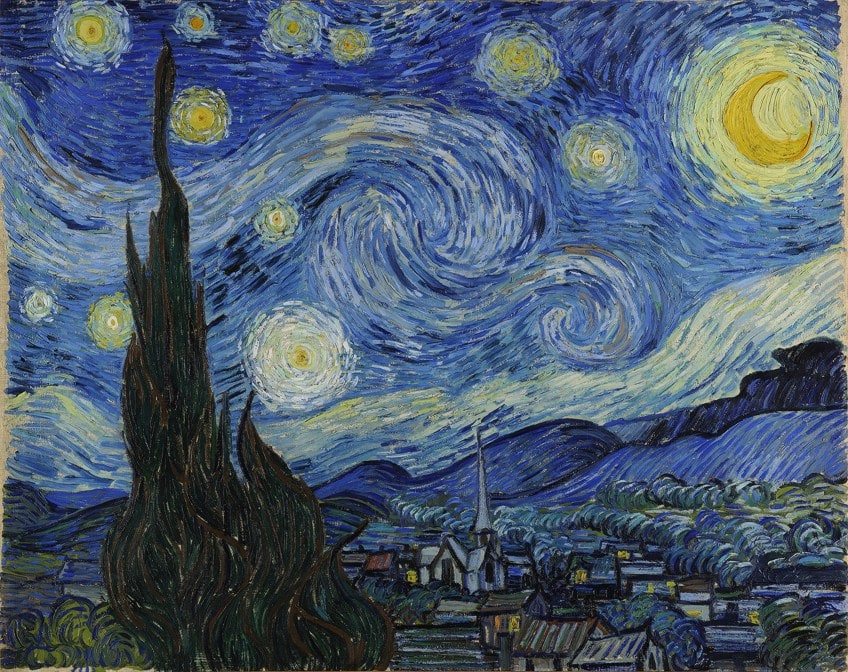 The Starry Nighttime (1889) by Vincent van Gogh; Vincent van Gogh, Public domain, via Wikimedia Commons
Progressive Rhythm
Progressive rhythm in art occurs when whatsoever art element, for example, color, shapes, or forms, arranged in a sequence or design is changed. The word progression implies an advocacy or forward move of either a series or sequence of objects or figures. Nonetheless, information technology tin can also mean that something advances or recedes in size in infinite.
Progression is demonstrated by how art elements are utilized in a composition.
These can change in size or shape, or they can remain the aforementioned merely but exist viewed from an angled perspective in infinite, which will give them a progressive appearance, otherwise, art elements can be in different colors giving it the appearance of progression.
Progressive rhythm fine art examples of the to a higher place-mentioned ideas can include different shapes like squares or rectangles placed in different consecutive sizes, for example, the famous Three Flags (1958) by the American artist Jasper Johns.
In this painting, there are three American flags placed on height of the other, still, each flag becomes larger in size every bit it receded into the background; the top flag is the smallest allowing the states to meet the other 2 backside information technology.
Another example includes the X-ray of Nautilus Shell (c. 1910) by Edward Charles Le Grice, which is a clear illustration of how progressive rhythm unfolds; the trounce's segments become larger from the inside out, and smaller vice versa.
Random Rhythm
Random rhythm in fine art refers to the random application of fine art elements; there is no club to how the sequences or patterns are placed in the limerick. This tin can include about any art element or fine art principle combined with one some other or utilized singularly. Although it might not appear ordered, sometimes information technology tin be planned to announced matted. Furthermore, it tin be geometric, abstruse, or more figurative subject matter.
Random rhythm in fine art tin can create more diversity in composition, leading our gaze hither and thither, keeping u.s.a. always engaged. However, random rhythm in fine art tin too pose challenges if it is not depicted accurately.
Some random rhythm art examples include the famous Abstruse Expressionist Jackson Pollock and his big canvases of splashed and dripped paint. For example, Autumn Rhythm: Number 30 (1950), in which we run into diverse colors of paint splashed onto the canvas in what appears as lines, some are long, brusque, thick, thin, curved, twirled, and linear. There are also various dots of paint.
In Pollock's Blue Poles (1952) we also see streaks of paint covering the canvas and around eight vertically linear streaks of paint spaced beyond the canvas. Pollock produced numerous of these types of paintings, also referred to every bit "all-over" or "action" paintings. Some other common random rhythm in art example is Young Corn (1931) by the American artist Grant Wood.
In this painting, nosotros see a landscape of expansive fields leading into the distance. There are different rhythms depicted in this composition, which makes it random.
The rhythm examples include the undulating hills and curved lines from the route, the line of the copse to the right, as well as the lines from the fields that mold along the smooth curves of the hills. These all announced flowing in their rhythm and there is also a regular rhythm depicted in the plowed field in the foreground, the middle ground, and far background.
Undergrowth with Two Figures (1890) by Vincent van Gogh depicts different rhythms, for example, the repeated rows of trees leading into the background suggests a progressive and regular rhythm, it also creates the upshot of stillness with its consistency and structured organisation.
When we look at the grass, there appears to be more movement, an energetic rhythm is created by how van Gogh utilizes texture here as well as short and choppy brushstrokes. Additionally, more than color is utilized for the flowers and bushes, the lesser area is filled, all giving it a livelier feeling compared to the monotones of the trees equally well as the larger areas of infinite between them.
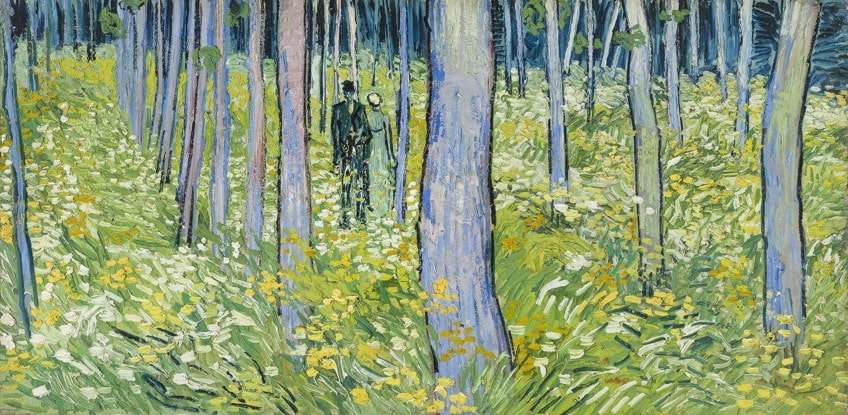 Undergrowth with 2 Figures (1890) by Vincent van Gogh; Vincent van Gogh, Public domain, via Wikimedia Commons
Summary of Rhythm in Fine art
| Rhythm in Art Techniques | Characteristics | Rhythm art examples |
| Regular Rhythm | Consistent repetitions or patterns of fine art elements. | Fall Plowing (1931) by Grant Woods |
| Alternate Rhythm | Dissimilar motifs are arranged in alternating patterns or sequences. | Lizard (1942) past M.C. Escher |
| Flowing Rhythm | Follows more than curved, circular, and fluid forms, frequently taken from "organic" forms in nature. | The Great Wave off Kanagawa (1831) past Katsushika Hokusai |
| Progressive Rhythm | A pattern or sequence of fine art elements changing in shape or size, sometimes it diminishes in size or enlarges in size. | Iii Flags (1958) by Jasper Johns |
| Random Rhythm | Uses one or more different types of rhythms in art compositions. | Autumn Rhythm: Number 30 (1950) by Jackson Pollock |
In the commodity in a higher place nosotros discussed what rhythm in art is, as one of the principles of art, rhythm provides a visual composition with a sense of dynamism. Information technology can give an artwork character and lead our gaze towards the focal betoken, several focal points, or no focal points, just only the unabridged composition.
Rhythm in art is depicted by a serial or sequence of patterns that are oftentimes repeated, these consist of art elements like color, line, shape, form, texture, and space. There are also different types of rhythms in art that we explored, namely regular, alternating, flowing, progressive, and random.
Principles of Art – Further Readings
- Principles of Fine art main commodity
- Movement in Art
- Emphasis in Art
- Unity in Art
- Texture in Art
- Proportion in Art
- Remainder in Art
- Harmony in Art
Rhythm in art adds diversity and variety to a visual art composition, without a sense of rhythm the artwork would be almost lifeless and lack a crush. Every bit it is in music also, rhythm provides a foundation of movement or motion that tin can exist practical in many ways, merely like a song can be played in many different tunes, and information technology can appear fast or slow-moving.
Oft Asked Questions
What Is Rhythm in Art?
Rhythm in art is one of the principles of art that gives an art composition movement, movement, or dynamism. It leads our gaze to the primary focal point or several focal points in an artwork. Rhythm can as well exist depicted with several techniques. Depending on how it is depicted it can make an artwork livelier, calm, or energized.
What Are the Types of Rhythm in Art?
There are five types of rhythm in art, namely, regular rhythm, alternating rhythm, flowing rhythm, progressive rhythm, and random rhythm, which tin exist a combination of whatsoever of the above types of rhythms.
What Are the Principles of Art?
The principles of art, namely, remainder, harmony, variety, rhythm, movement, emphasis, proportion, scale, and unity are described every bit "principles of organization". These are like guiding rules that decide how artists or designers can use art elements, which are color, value, line, texture, shape, form, and infinite, in a limerick. Following the principles of art in artworks will ensure it is a unified whole where all the necessary elements work together.
Source: https://artincontext.org/rhythm-in-art/
0 Response to "Balance Art Definition Movement and Rhythm in Art Definition"
Enviar um comentário